01
The Chronicle
A physical family history, professionally written, edited, and designed from your family’s record. Made to be read together and passed on.
A commissioned family publishing studio
by Unwindology Press
Your family brings the voices, photographs, and memories. We bring the questions, organization, writing, and design—shaping them into a factual family Chronicle and an archive your family can keep.
Begin with an introductory conversation about your family and what you hope to preserve. A few sentences are enough.
A book to hold.
A record to keep.
You do not have to organize it first
The shoebox in the cupboard. The photographs on your phone. Albums, letters, recipes, certificates, newspaper clippings, and family-tree fragments. A recording, a home movie, a half-remembered name.
You do not need a finished genealogy, a timeline, neatly labeled photographs, or a relative ready to write a memoir. We help decide what matters, connect what belongs together, and find the next useful question.
A little is enough to begin. It does not all have to arrive at once.
What your family receives
The finished work and the record behind it come home together. Your private commission scope defines the production, files, and archive handoff.
A physical family history, professionally written, edited, and designed from your family’s record. Made to be read together and passed on.
Professionally prepared production and digital files associated with the finished commission. A durable part of what your family receives.
The organized, portable source collection behind the book—photographs, documents, recordings, and their context—prepared for return to your family.
A whole family can hold the story
Your mother remembers one chapter. Your father supplies another. A cousin knows the other branch; a sibling recognizes the faces.
We bring those perspectives together while keeping clear who remembers what. One family member can help coordinate decisions without having to know—or write—the whole history.
How relatives participateDifferent voices. A fuller history.
“I remember the house.”
“I have the letter.”
“I thought it happened a year later.”
Different memories are part of the record. We look for context, preserve attribution, and leave uncertainty visible when it cannot be resolved.
Illustrative examples of family contributions.Inside a Chronicle
A family picture can carry a place, a relationship, a remembered afternoon, and a question worth keeping.
Illustrative Chronicle study. The family, photograph, letter, dates, and recollections below are fictional. This is a demonstration of editorial treatment, not a completed client project.
A family Chronicle Illustrative study
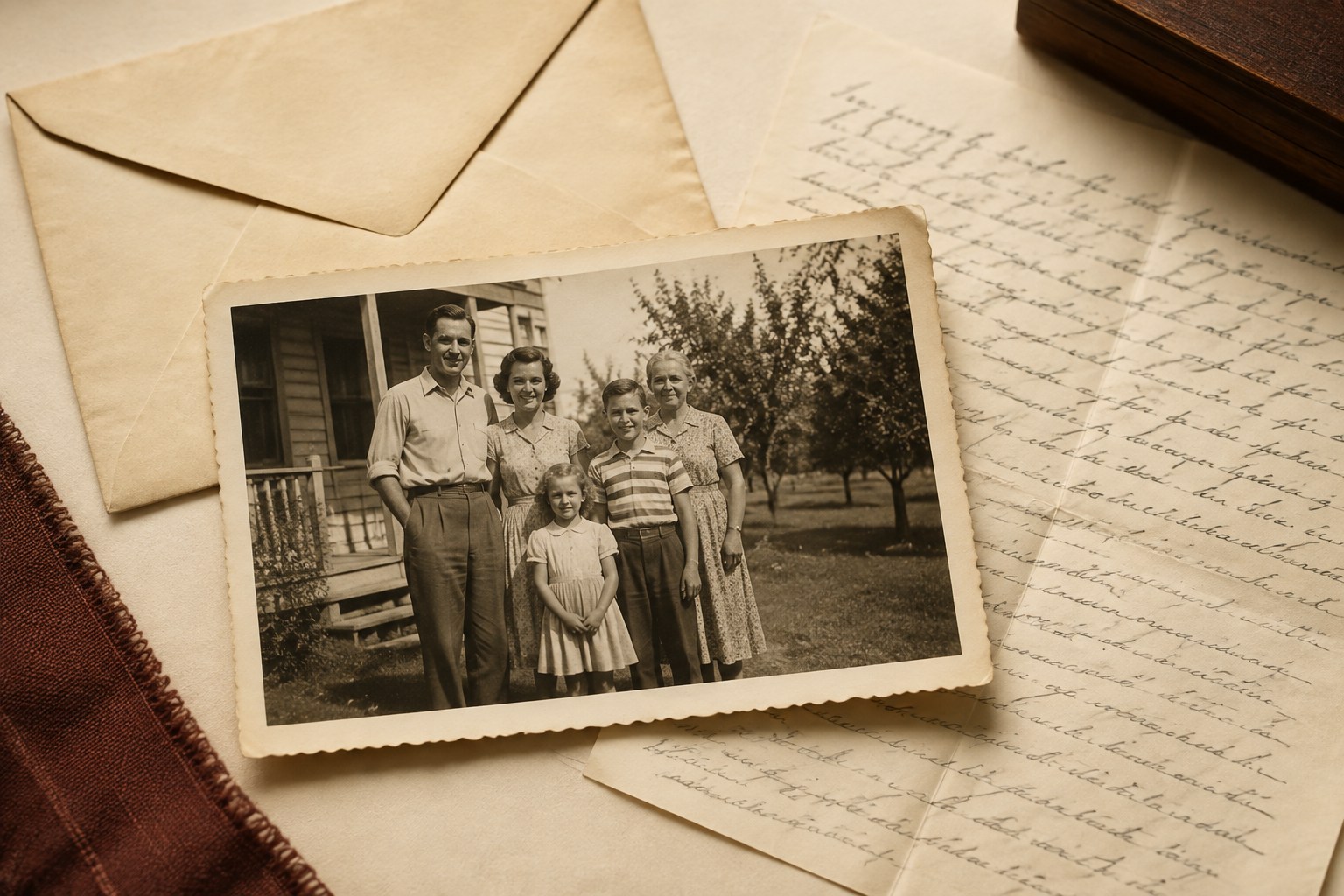
Ruth & Daniel · siblings
Their parents · their grandmother
A place remembered Family voices
To Ruth, the photograph belonged to the summer before the move. Daniel placed it later. Both remembered the orchard; neither could settle the year.
“There was always room for one more chair on that porch.”— Ruth, remembering her grandmother’s house
Ruth recalls the move in 1954. Daniel remembers 1955. An undated letter mentions packing, but cannot establish the year. The Chronicle preserves both recollections and leaves the date open.
A beautiful narrative can make room for more than one memory.
Explore the study and its sourcesFrom memory to Chronicle
Listening is only the beginning. The commission includes the patient editorial work of connecting people, dates, photographs, and accounts—and turning that record into a book.
Follow the complete processWe preserve who supplied it, who remembers it, and the context that gives it meaning.
We compare accounts and records, clarify people and relationships, and ask focused questions about dates and gaps.
You help correct, clarify, and approve the record. Uncertainty stays visible; invented details do not become facts.
The finished work, production files, and organized archive go home to the family. Working materials follow the agreed closeout plan.
A different scope of work
Self-guided memoir products can help someone answer prompts and collect their story. A commission brings an editor and a publishing process to the material a whole family holds.
Guided contributions, photographs, documents, and follow-up shaped around your family.
Chronology, relationships, source handling, writing, editing, and family review. Technology assists; Douglas Chapman remains accountable.
Professional publishing and an organized return, with ownership and closeout established in the commission agreement.
There are many ways to begin
Temporary stewardship. Lasting family ownership.
We need working custody to organize, edit, and prepare the commission. Your family receives an organized export, reviews the delivery, and confirms receipt before the agreement-defined closeout process.
The archive is built to remain useful without an ongoing hosted subscription. Third-party rights and provider retention limits are addressed plainly.
How we care for your materialsThe founding families
Kin & Chronicle is developing its founding family projects and welcoming inquiries for a small number of custom commissions. Douglas works directly with each family; start windows reflect the attention the work requires.
Founding participation helps refine the studio’s process and permanent standards. Current availability is confirmed in conversation.
Meet the founding stageBefore you begin
Participation, evidence, ownership, and what happens next—explained before you share private family material.
Explore all questionsYou do not need an organized archive, finished genealogy, timeline, or polished interviews. Photographs on phones, old albums, letters, recipes, documents, voice recordings, digital folders, and half-remembered stories are all possible starting points. In the conversation, we discuss what exists and plan manageable rounds of contribution. Any physical handling, scanning, or digitization needs are agreed in scope before material is sent.
Read this answerYour mother may remember one period, your father another. A cousin may know a different branch, and a sibling may identify photographs. Each contribution keeps its attribution, including when accounts disagree. We agree who may contribute, review, and approve, with a family coordinator helping consolidate decisions. One person does not have to be the sole storyteller or author.
Read this answerDifferent recollections do not have to be forced into one answer. The record can preserve who remembers what, where accounts overlap, and what remains unresolved. The studio may ask whether another source or person can clarify the issue, but it does not silently select a winner or overwrite an earlier contribution. The Chronicle may use attribution, qualified language, parallel accounts, or deliberate omission depending on relevance, sensitivity, and the approved plan.
Read this answerWorking custody lets Kin & Chronicle carry out the commission; it does not turn your private collection into a permanent hosted subscription. The agreement defines ownership and use of the finished work. Rights held by photographers, newspapers, archives, and other third parties still apply to their material and are carried through the record.
Read this answerWe prepare the organized export and a guide to its contents, check the handoff, and ask the family to confirm the archive is received and readable. An agreement-defined grace period comes before the agreed deletion and retention actions for working copies. Closeout actions and exceptions are documented. Provider retention limits, necessary business records, and separately authorized public material are addressed in the agreement. The service is not built around permanently hosting your archive.
Read this answerUse the short inquiry to tell us about your family and what prompted you to begin. The form prepares an email for you to review and send. In the introductory Story Map conversation, we explore likely storytellers, branches, available material, and important unanswered questions. If the project fits, Douglas prepares a private scope and proposal. There is no obligation to commission and no need to upload an archive or decide a page count first.
Read this answerBegin with a conversation
Request a Story Map: an introductory conversation about your family, likely storytellers, branches, and the material you already have. If the fit is right, we develop a custom commission scope. There is no obligation to commission.
Request a Story Map